Import your agent workflows
in one click.
OpenAI is winding down Agent Builder. Invoked imports your work directly: export from Agent Builder, drop it in, and your prompt, model, tools, and connections land on a visual flow canvas, ready to run. Local-first, MCP-native, free to start.
No credit card. No account required to start. macOS · Windows · Linux.
Everything you know, and then some
The canvas you know. The depth you wanted.
Everything you did in Agent Builder, you do here: compose agents visually, wire them with typed connections, gate them with guardrails. Then the ceiling lifts. Real MCP tools, full run traces, evals against a baseline. And when it works, Run & Ship hands you real integration code (React, TypeScript, Angular, Vue, Svelte) to drop straight into your product. No hosted runtime, no lock-in.
Drag agents onto a canvas and wire them into flows that run in dependency order.
Connections carry types, so invalid wiring is caught as you build — not at runtime.
Attach guardrails to specific phases of a run instead of one global filter.
Score every change against a baseline with an LLM judge, right beside the flow.
Connect real MCP servers, tool sets, and your own APIs — switch between them with a keystroke.
Runs on your machine. Your keys and run history never leave it.
Run your agent live, then export portable code (React, TypeScript, Angular, Vue, Svelte). No hosted runtime, no lock-in. Your front-end team drops it straight into your product.
Your keys, prompts, and run history stay on your machine. Built to pass enterprise security review.
Keep your OpenAI keys, or bring Anthropic, local Ollama models, anything. Pin a model per agent.
Turn a winning run into a versioned, reusable skill. Full traces, evals, and a baseline to beat.
Built for Agent Builder, specifically
Import in four steps.
Invoked detects the OpenAI Agent Builder format on upload, so you know right away it understood your file. No generic guesswork.
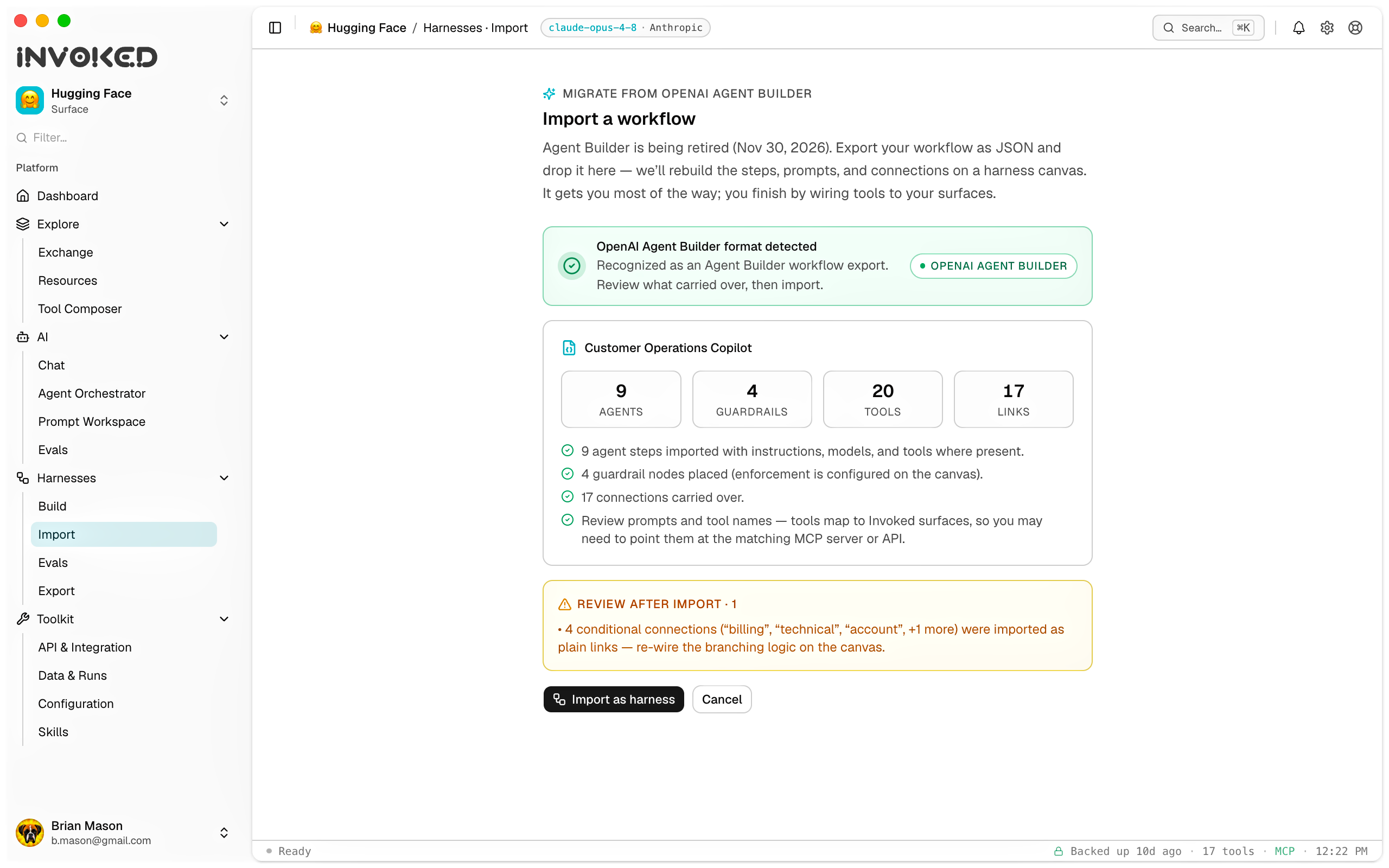
Invoked confirms the OpenAI Agent Builder format, then maps your workflow onto the canvas.
- 1Export from Agent Builder
Open your workflow or prompt in Agent Builder and export the JSON it provides.
- 2Import into Invoked
Download Invoked (free, no card), open Import, and choose your file. Invoked detects the OpenAI Agent Builder format and shows what it found.
- 3Review and connect
Your instructions, model, and tools land on the canvas. Invoked flags anything to refine, like conditional branches or tools to point at your own services.
- 4Run, eval, and lock it in
Run the flow, watch the full trace, score it against a baseline, and save the winning version as a reusable skill.
Honest about the fit: Invoked imports what Agent Builder lets you export and tells you exactly what carried over and what to review. You land on a real, editable harness instead of a blank canvas.
Questions about leaving Agent Builder
When does OpenAI Agent Builder shut down?
OpenAI has announced that Agent Builder (part of AgentKit) is being deprecated, with a shutdown on November 30, 2026. After that date, workflows built there will stop running, so teams relying on it need a new home before the deadline.
Is Invoked a drop-in replacement for Agent Builder?
Invoked covers the same job (visually composing agent workflows with tools, guardrails, and evaluation) through its harness flow canvas. And you do not start from scratch: Invoked has a built-in importer for OpenAI Agent Builder. Export your work from Agent Builder, drop it into Invoked, and it rebuilds your prompt, model, tools, and connections as a harness you can run and refine.
How does the Agent Builder importer work?
Export your workflow or prompt from Agent Builder (the JSON it gives you), then open Invoked and choose Import. Invoked detects the OpenAI Agent Builder format, maps your instructions, model, and tools onto a harness on the canvas, and shows you exactly what came across plus anything to review (like conditional branches or tools to point at your own services). You finish it on the canvas and run it.
What does Invoked do that Agent Builder did?
A drag-and-drop canvas to wire agents into flows, typed connections between nodes, phase-scoped guardrails, and inline evals that score every change against a baseline. It is MCP-native, so it connects to real tools — GitHub, Hugging Face, your own APIs — and local-first, so your keys and run history stay on your machine.
Do I have to use OpenAI models with Invoked?
No. Invoked is model-agnostic — bring OpenAI, Anthropic, local Ollama models, or anything you connect. You keep your existing OpenAI API keys and can pin a specific model per agent.
How much does Invoked cost?
There is a free trial, no credit card, no account required to start. Solo is $15/mo (or $149/yr), Team is $25/seat. Students and educators get Solo free. You can migrate and test your workflows before paying anything.
Where does my data live?
Invoked is local-first: your keys, configs, prompts, and run history stay on your machine. Only anonymized, aggregate metrics ever leave — no prompts, no credentials, no PII.
Bring your agents home.
Do not wait for the deadline. Download Invoked, import your workflow, and keep building on a tool you own.
Free trial · No credit card · macOS, Windows & Linux